
In the “Red Storm Business” emergency exercise, initiated by the Hamburg Chamber of Commerce (Handelskammer Hamburg), Hamburg companies were asked to test their emergency plans for a crisis.
That was not enough for us. We wanted to raise the level of difficulty to put our resilience to an even tougher test for a real emergency. We found out how resilient we are – and much more: companies need to network more.
In this article, I show:
- which requirements the Chamber of Commerce had set,
- how we made our own exercise even tougher,
- what our emergency plan contained,
- what we learned from the exercise,
- why closer networking between companies matters for resilience.

The requirements of the Hamburg Chamber of Commerce
Under the title “Red Storm Business”, the Chamber of Commerce invited Hamburg companies to test their own crisis preparedness on 24 September.
The shared starting scenario: a prolonged power outage.
Besides technical checks, the Chamber of Commerce explicitly focused Red Storm Business on communication, physical infrastructure and the question of which business processes are the minimum necessary.
Although the Chamber had suggested various modules, it explicitly left room for exercises of each company’s own design.
Adding more spice: we wanted more
We were keen to use the creative freedom the Chamber of Commerce had left despite its requirements and designed our own exercise scenario. On the one hand, we wanted to extend the exercise so that it would serve the whole Silpion group as an emergency exercise for the ISO 27001 certification as well. On the other hand, it was to answer a central question: what do we really need to be able to work?
To find out, we did without as many of the things we take for granted on a normal working day as possible:
- mains power
- a normal internet connection
- access to our cloud systems and communication channels
- an equipped workplace
Instead, we simply stood in the car park in front of our office building, and all of that was gone.
A few journalists, however, were there.
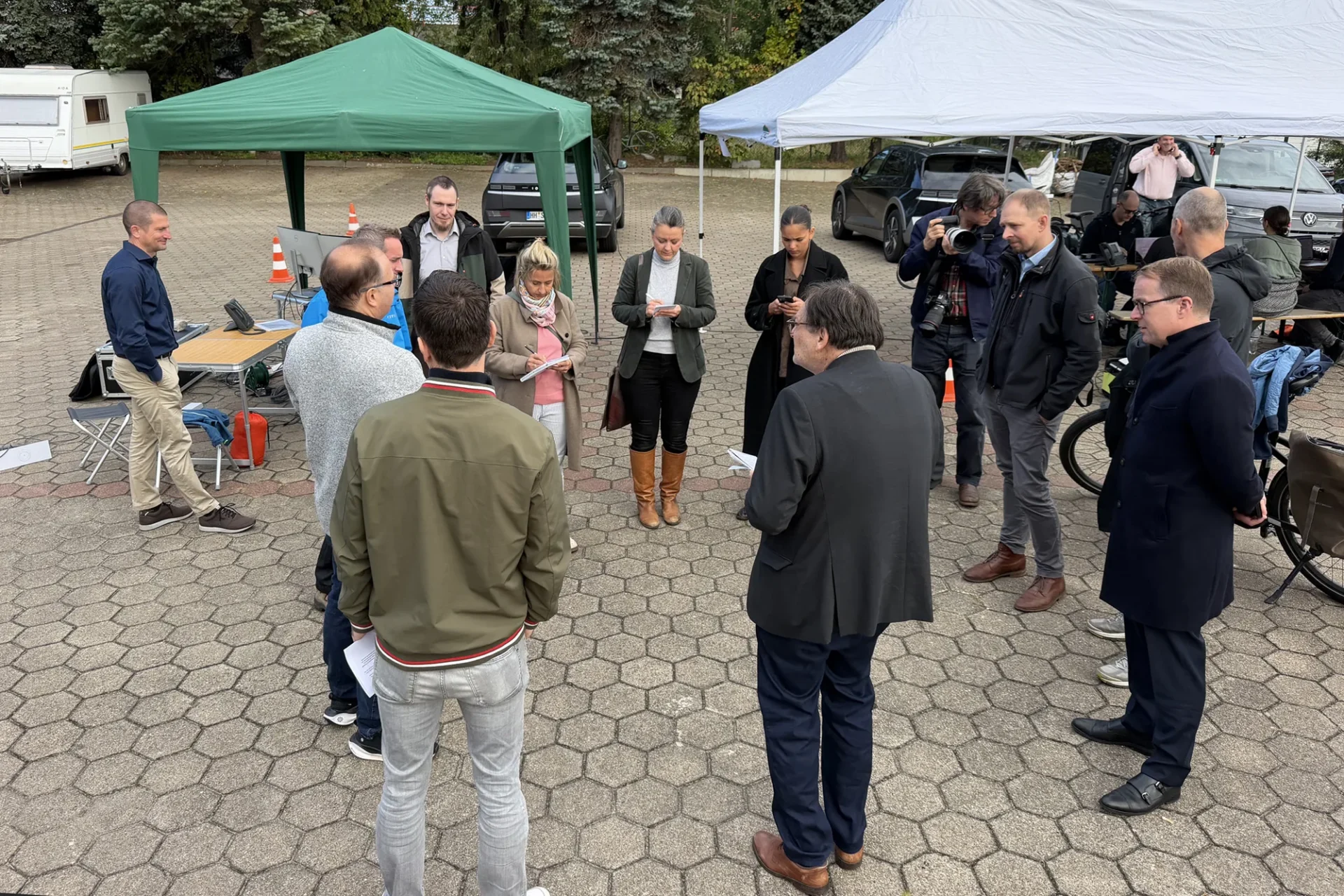
Off we go: introduction to the exercise conditions and the emergency plan
The emergency plan: beer table, electric car, Starlink
Power from the electric car
First and foremost, the exercise required power from alternative sources. We had prepared mobile battery storage, but also the vehicle-to-load (V2L) function of electric vehicles.
For the journalists, this was the eye-catcher. It also shows: simple technical solutions like these are far too little known or tested.
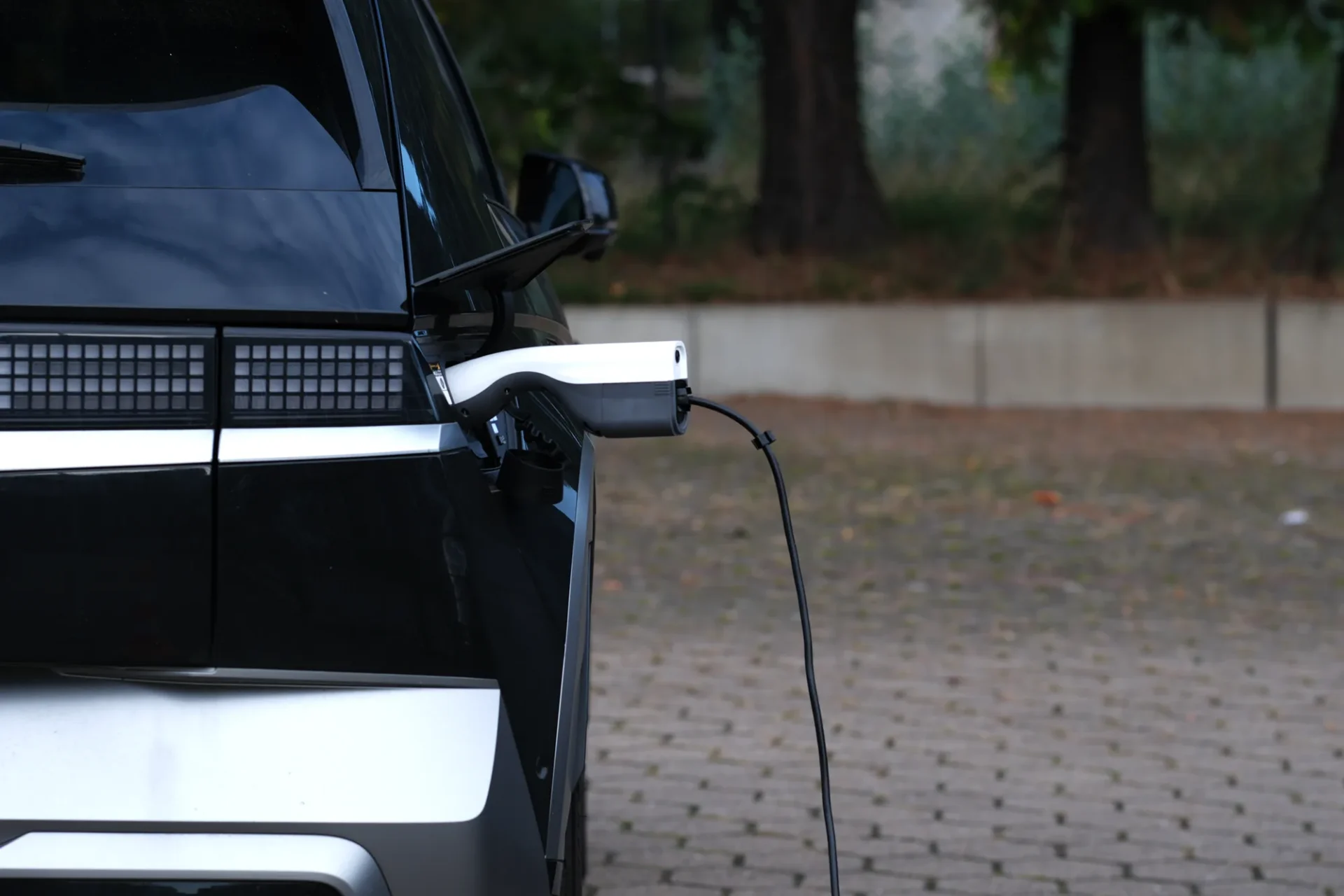
The most photographed subject: drawing power from an electric car with the V2L adapter
Communication via 5G, Starlink and voice over IP
The internet connection was established via 5G and Starlink, independently of our normal fibre-optic lines.
We had also connected five VoIP phones to a mobile SIP server we built ourselves, which provided telephone connections to the outside world via satellite. We used two geographically independent providers in Germany and the USA; with the US provider, we used the access point in Brazil.
Eight beer-bench workplaces and a mobile gas grill
Everyone had to work from an unconventional alternative location: beer benches and tables were set up in the car park. Colleagues had only laptops – running Linux and FreeBSD instead of the usual Windows and macOS operating systems.
Connected to the electric cars, two Starlink terminals and a 5G router, we had eight notebook workplaces in total and one demo workplace with two monitors.
Hot food was planned, too, if not a luxury menu: pizza came from a mobile gas grill; the electric grill was plugged into one of the electric cars, and we used it to make toast Hawaii as well. Typical German food, after all.
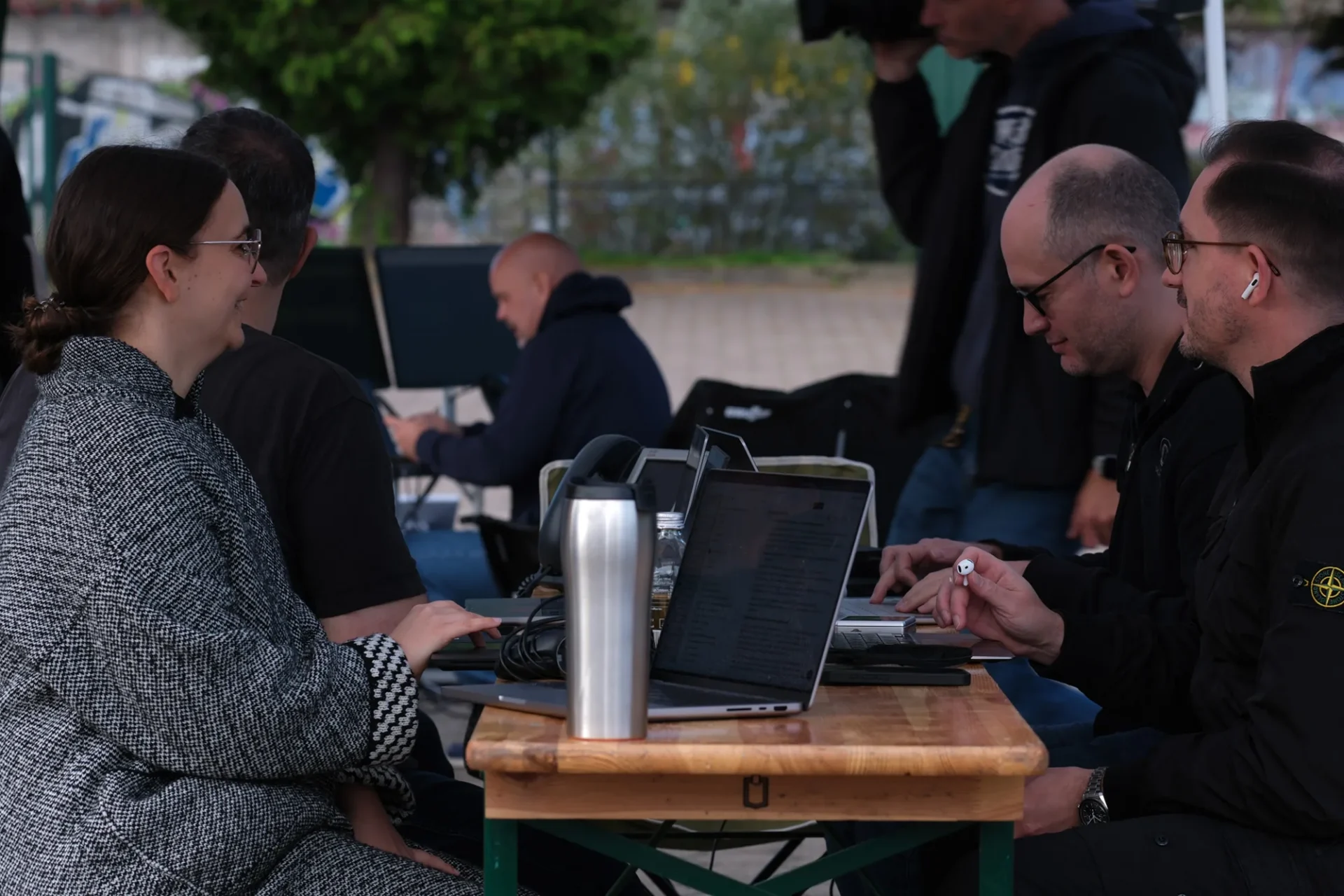
A beer bench and a laptop have to do: the site was deliberately spartan
What we learned
Energy
This part turned out very positive for us. With the setup we used, the 55 kWh from one electric car would have given us enough power for more than a week.
With the 139 kWh from two electric cars, our setup would have had enough power for the workplaces for more than two weeks. And the coffee machine was, of course, 100% operational.
Internet
The alternative internet access worked well. One colleague even remarked that the connection was faster than his DSL in his home office.
Data and software
This was the more exciting part. We wanted to find out whether sign-ins worked and whether employees could use their applications as usual. The backup systems we had set up in preparation basically worked. At the same time, this is where most further work is needed. The good thing about the exercise: now we know what is still missing and where the departments still need to define requirements.
Beer tables and benches
The spartan “workplaces” were only fun because the weather played along – in winter, this setup would not be possible at all. Even so, they created the right atmosphere, made the emergency feel real and sharpened our awareness.
The most valuable result: new questions
Above all, new questions came up during the exercise. Many were very practical: how important is the coffee machine to us, and did we really need the satellite phones? But some pointed to the future: who could support us with something we lack, and whom could we help with what we have built here?
Over the course of the day, it became increasingly clear that this is a major key to greater resilience.

Conclusion: more networking for when the network is down
To become more resilient overall, companies in Hamburg and beyond need to cooperate even more closely in future. They have very different capabilities, which may be a matter of course for themselves but can be extremely valuable to others in a crisis.
If companies discover, share and connect these capabilities early on, a robust network can emerge before a crisis. That is why we are ready to make the part we have tested available to others.
So please get in touch with any questions about our exercise setup and the solutions we used.
About the author

Christian Schmidt
Principal IoT Producer
Christian Schmidt is an authorised signatory at Simplexion, a subsidiary of Silpion IT-Solutions. Simplexion develops digitally sovereign, cyber-secure electronics and firmware for products and delivers innovations in electronics and software for connected and IoT-enabled devices.
As Principal IoT Producer, Christian is responsible, amongst other things, for product development, customer requirements and technical solution architectures.
Media coverage (in German)
Hamburger Abendblatt
Read the article on abendblatt.de
Sat.1 Regional
Watch the report on sat1regional.de
Further information (in German)
Official website of the Hamburg Chamber of Commerce
Red Storm Business on handelskammer-hamburg.de